1. Introduction
The Internal Combustion Engine (ICE) is a type of engine where the combustion (burning of fuel) occurs inside the engine itself. This process generates mechanical energy that drives the engine. ICEs have been widely used in various applications, including automobiles, airplanes, ships, and power generation. The development and widespread use of ICEs revolutionized transportation, industry, and technology.
2. History of the Internal Combustion Engine
The history of the ICE spans several centuries, with multiple inventors contributing to its development. Here’s a brief timeline:
- 1673 – Early Concepts: The concept of internal combustion goes back to early inventors like Christiaan Huygens, who built the first recorded internal combustion engine, powered by gunpowder. However, it was rudimentary and not used in practical applications.
- 1807 – First Practical Engine: François Isaac de Rivaz, a Swiss engineer, built the first practical internal combustion engine powered by hydrogen. This engine was used to power the first vehicle powered by internal combustion—an early attempt at creating an automobile.
- 1860 – The Lenoir Engine: Belgian engineer Jean Joseph Etienne Lenoir created one of the first commercially successful internal combustion engines. It was a single-acting, two-stroke engine, powered by coal gas, and it helped in the development of early vehicles.
- 1876 – The Otto Engine: Nikolaus Otto, a German engineer, developed the first successful four-stroke internal combustion engine, known as the Otto engine. This engine cycle became the foundation for gasoline engines used in cars today. The engine had a higher efficiency than earlier designs and incorporated the concept of compression ignition, where the air-fuel mixture is compressed before ignition.
- 1885 – The First Gasoline-Powered Car: Carl Benz, a German inventor, built the first vehicle powered by an internal combustion engine, the Benz Patent-Motorwagen. This is considered the birth of the modern automobile.
- 1892 – The Diesel Engine: Rudolf Diesel, a German engineer, invented the Diesel engine, which works on the diesel cycle. Diesel engines are more fuel-efficient than Otto engines, as they use compression ignition and are designed to operate at higher compression ratios.
- 20th Century – Mass Production: In the early 1900s, ICEs became the power source for mass-produced cars, with manufacturers like Henry Ford revolutionizing automobile production with the assembly line. By the 1920s, ICEs had become the dominant power source for automobiles.
- Late 20th Century – Modern Advancements: In the latter half of the 20th century, internal combustion engines were continuously refined for better performance, efficiency, and emissions. Advances in fuel injection, turbocharging, and electronic control systems helped improve ICE efficiency and reduce pollutants.
3. Types of Internal Combustion Engines
There are different types of internal combustion engines based on their fuel type, cycle, and design. These include:
a. Based on the Fuel Type
- Gasoline Engines: Most commonly used in cars, these engines operate on the Otto cycle and use gasoline as fuel.
- Diesel Engines: These operate on the Diesel cycle, using diesel fuel. Diesel engines are generally more fuel-efficient than gasoline engines but tend to produce more nitrogen oxide and particulate emissions.
- Natural Gas Engines: These engines run on compressed natural gas (CNG) and are commonly used in trucks and buses.
- Hybrid Engines: These combine an internal combustion engine with an electric motor, allowing for improved fuel efficiency and reduced emissions.
b. Based on the Thermodynamic Cycle
- Otto Cycle: The most common cycle in gasoline engines, where fuel is ignited by a spark plug.
- Diesel Cycle: Found in diesel engines, where the fuel ignites due to high pressure and temperature in the cylinder.
- Atkinson Cycle: A variation of the Otto cycle, used in some hybrid vehicles. It emphasizes higher thermal efficiency at the expense of lower power output.
c. Based on the Configuration
- Single Cylinder Engines: These engines have a single combustion chamber and are often used in small vehicles, like motorcycles and lawn mowers.
- Multi-Cylinder Engines: These engines, typically found in cars, trucks, and other heavy-duty machinery, have multiple cylinders for increased power output. These can be arranged in various configurations, such as inline, V-type, or flat engines.
4. Function and Working Principle of an Internal Combustion Engine
An internal combustion engine operates by converting the chemical energy of fuel into mechanical energy through the process of combustion. This is achieved by burning fuel inside the engine’s cylinders, which creates expanding gases that push the engine’s pistons, generating power.
The Four-Stroke Cycle (Otto Cycle)
The most common cycle in modern gasoline engines is the four-stroke cycle, which consists of the following stages:
- Intake Stroke: The intake valve opens, and the piston moves down, drawing in a mixture of air and fuel into the cylinder.
- Compression Stroke: The intake valve closes, and the piston moves up, compressing the air-fuel mixture.
- Power Stroke: As the piston reaches the top, the spark plug ignites the compressed air-fuel mixture, causing it to explode. This pushes the piston down, generating power.
- Exhaust Stroke: The exhaust valve opens, and the piston moves up again, expelling the burnt gases from the cylinder.
Diesel Cycle
In a diesel engine, the air is compressed to a much higher degree, causing the air temperature to rise. When fuel is injected into the cylinder, it ignites due to the heat of compression, without the need for a spark plug.
5. Key Components of an Internal Combustion Engine
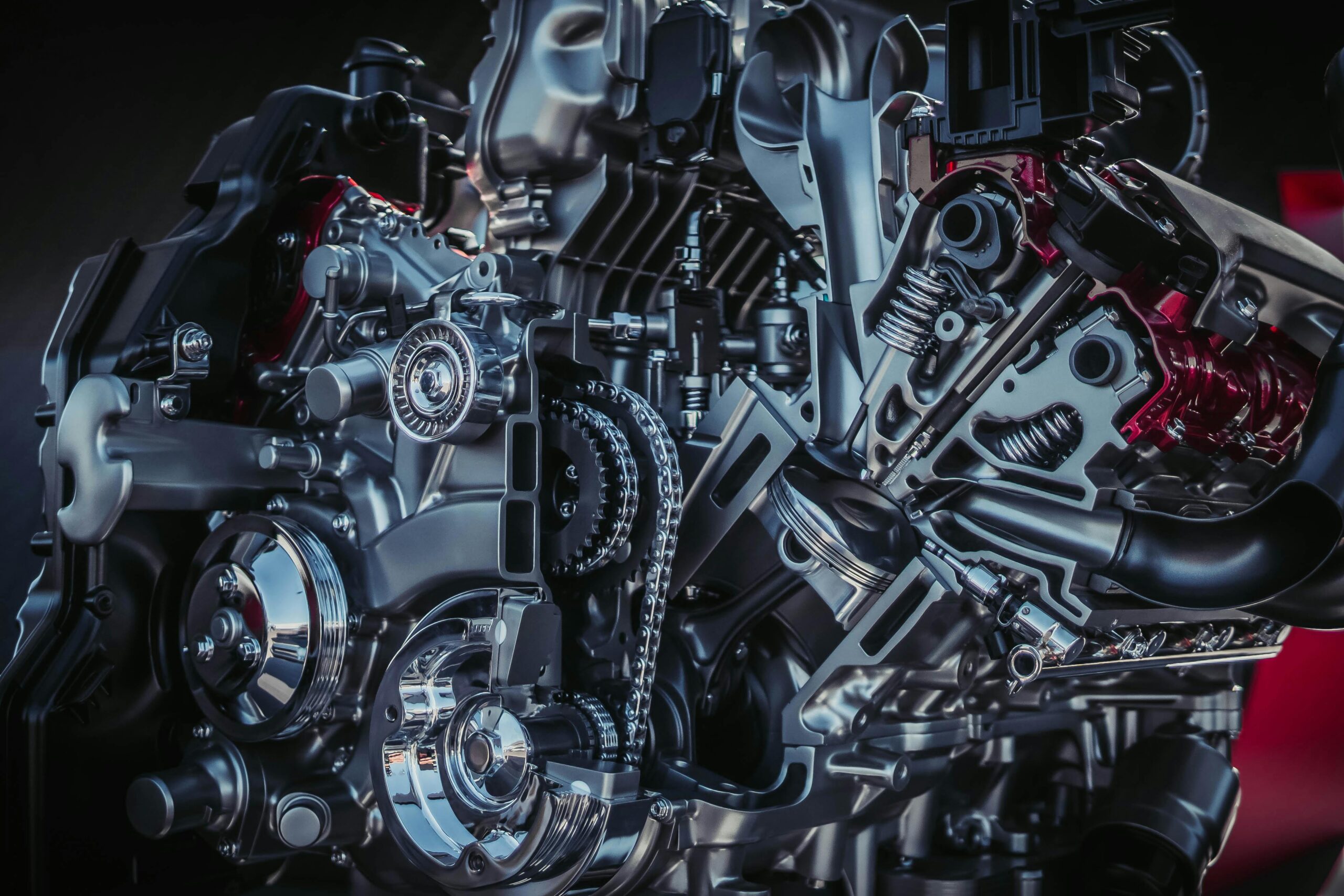
- Cylinder: The chamber where combustion takes place.
- Piston: A movable component that transfers the power from the combustion gases to the crankshaft.
- Crankshaft: Converts the up-and-down motion of the pistons into rotational motion.
- Valves: Regulate the intake of air-fuel mixture and the exhaust of combustion gases.
- Spark Plug: In gasoline engines, it ignites the air-fuel mixture by generating a spark.
- Fuel Injector: In modern engines, it injects fuel into the cylinder, ensuring the proper air-fuel mixture for combustion.
- Exhaust System: Removes the gases produced by combustion from the engine.
6. Applications of Internal Combustion Engines
Internal combustion engines have been applied in a wide range of areas, including:
- Automobiles: Gasoline and diesel engines power most cars, trucks, and buses.
- Aviation: Small aircraft and private planes are often powered by ICEs, typically using aviation gasoline or Jet-A fuel.
- Marine: ICEs are used in boats and ships, often running on diesel fuel.
- Industrial Machinery: ICEs power various types of construction and agricultural equipment.
- Electric Power Generation: Some power plants use ICEs to generate electricity, particularly in remote or emergency settings.
7. Advantages of Internal Combustion Engines
- High Energy Density: Fuel used in ICEs (such as gasoline and diesel) has a high energy density, providing more energy per unit of fuel.
- Established Infrastructure: ICEs benefit from a well-developed infrastructure, including refueling stations, maintenance services, and repair shops.
- Powerful Performance: ICEs are capable of producing significant amounts of power, making them suitable for heavy-duty applications.
8. Disadvantages of Internal Combustion Engines
- Environmental Impact: ICEs contribute to air pollution, including carbon dioxide (CO2), nitrogen oxides (NOx), and particulate matter. This is a major concern in the context of climate change.
- Efficiency Losses: Despite advancements, ICEs are less efficient than electric motors, with a significant portion of energy lost as heat.
- Reliance on Fossil Fuels: Most ICEs depend on fossil fuels, which are finite and contribute to environmental degradation.
9. Future of Internal Combustion Engines
The future of ICEs is shaped by several factors:
- Electrification: The shift towards electric vehicles (EVs) is reducing the reliance on ICEs for personal transportation.
- Hybrid Systems: Hybrid electric vehicles (HEVs) combine ICEs with electric motors, offering better fuel efficiency and lower emissions.
- Alternative Fuels: Research into biofuels, hydrogen, and synthetic fuels may offer cleaner alternatives to traditional gasoline and diesel.
- Regulation and Emissions Standards: Stricter emissions regulations will likely continue to drive advancements in engine efficiency and pollution control.
10. Conclusion
The Internal Combustion Engine has been a key technology for over a century, powering everything from automobiles to airplanes and industrial machines. While advancements in electric and hybrid technologies are reshaping the future of transportation, ICEs will remain an important part of the energy landscape for years to come. However, environmental concerns and fuel efficiency will continue to drive research and innovation in the field.
https://www.pexels.com/photo/silver-car-engine-in-close-up-photography-11455717/