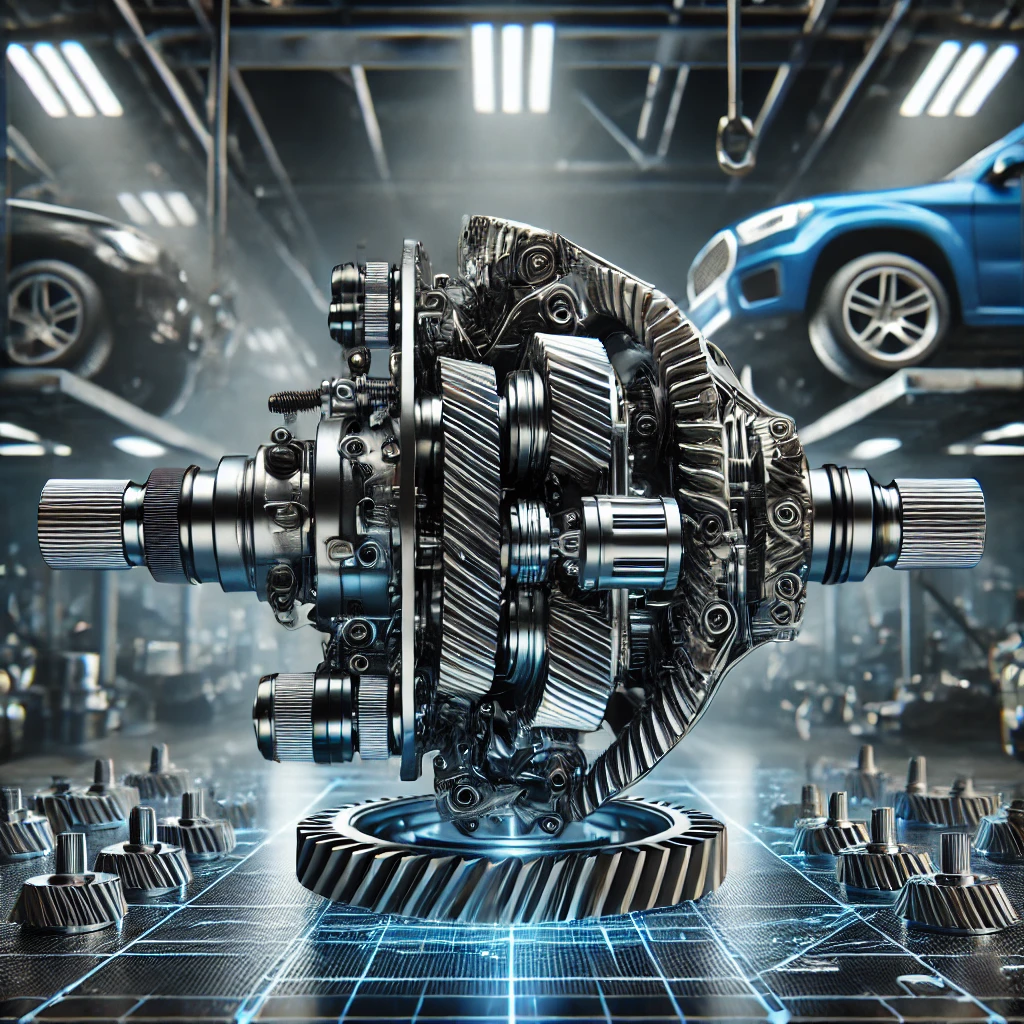
The differential is a crucial component in a vehicle’s drivetrain, responsible for allowing the wheels to rotate at different speeds while delivering power from the engine to the wheels. It is most commonly found in vehicles with rear-wheel drive (RWD), front-wheel drive (FWD), or all-wheel drive (AWD) configurations. There are various types of differentials, and the performance level can vary depending on the design, material, and intended use.
Stock Differential
A stock differential is the standard, factory-installed differential in most vehicles. It is designed for general driving purposes, such as commuting and occasional performance driving. Here’s a breakdown of its features:
Features of Stock Differentials
- Open Differential (Most Common)
- How It Works:
- Power is split equally between the two wheels on an axle. However, if one wheel loses traction (e.g., on ice or in a turn), the power is sent to the wheel with less resistance, causing the wheel with more grip to receive less power.
- Advantages:
- Simple, cost-effective design.
- Reliable for everyday driving.
- Disadvantages:
- Not ideal for high-performance driving, especially in slippery conditions (e.g., off-road or racing).
- How It Works:
- Limited Slip Differential (LSD)
- How It Works:
- Uses friction clutches, gears, or viscous fluid to limit the difference in speed between the two wheels, allowing some slip but preventing one wheel from spinning freely.
- Advantages:
- Improved traction in slippery conditions (e.g., rain, snow).
- Better handling and stability during cornering.
- Disadvantages:
- Still not as effective as high-performance differentials in extreme performance scenarios.
- How It Works:
- Cost & Durability:
- Stock Differentials are designed with cost and durability in mind, as they’re used in the majority of vehicles that don’t require extreme handling or performance.
- Maintenance: Regular oil changes and maintenance are generally enough for stock differentials.
High-Performance Differential
High-performance differentials are used in sports cars, performance vehicles, and racing cars. These differentials are designed to optimize traction, handling, and cornering, particularly under high-stress conditions like racing, off-roading, or aggressive street driving.
Features of High-Performance Differentials
- Limited Slip Differential (LSD) – Upgraded
- How It Works:
- Similar to a stock LSD but designed with high-performance materials and mechanisms for superior torque distribution.
- Can be either mechanical (using clutch packs, gearsets) or electronic (controlled by the car’s ECU to adjust power distribution).
- Advantages:
- Much higher torque transfer to the wheel with more grip, improving acceleration and handling, especially in sharp turns.
- Better performance in competitive or extreme driving conditions.
- More responsive and precise in maintaining traction.
- How It Works:
- Torque-Vectoring Differential
- How It Works:
- An advanced form of LSD that can actively vary the torque sent to each wheel independently, often controlled electronically.
- Common in AWD and high-performance sports cars.
- Advantages:
- Provides exceptional handling by selectively applying torque to the wheel that needs it most, improving cornering and traction in all driving conditions.
- Can adapt to various surfaces, providing better control during aggressive maneuvers.
- Disadvantages:
- More complex and expensive than traditional differentials.
- How It Works:
- Fully Locked Differential
- How It Works:
- Forces both wheels on an axle to rotate at the same speed, providing maximum traction (ideal for off-road or extreme racing).
- Advantages:
- Great for off-roading and rock crawling, as both wheels get equal power.
- Disadvantages:
- Reduces maneuverability on smooth, dry pavement because it doesn’t allow the wheels to rotate at different speeds when turning (causing tire wear and handling issues).
- How It Works:
- Helical or Torsen Differential
- How It Works:
- A type of LSD that uses helical gears to distribute torque. It works without the need for clutches or viscous fluids and is very smooth in operation.
- Advantages:
- Smooth, seamless operation, particularly during cornering.
- Better performance in both dry and wet conditions.
- Reliable and low-maintenance.
- Disadvantages:
- Typically more expensive and complex than open or simple LSD designs.
- How It Works:
Key Differences: Stock vs. High-Performance Differentials
| Aspect | Stock Differential | High-Performance Differential |
|---|---|---|
| Type | Typically open or basic limited-slip (LSD) | High-performance LSD, electronic or torque-vectoring differentials |
| Traction | Limited traction on slippery or uneven surfaces | Superior traction, optimized for high-performance or racing |
| Handling | Good for regular driving but limited in high-performance scenarios | Enhanced handling, better cornering, and stability at high speeds |
| Torque Distribution | Power evenly or limited to one wheel under certain conditions | Power can be adjusted dynamically to individual wheels |
| Complexity | Simple design, cost-effective | More complex, often with advanced electronics or mechanical systems |
| Cost | Relatively inexpensive | Expensive due to higher technology and materials |
| Maintenance | Requires periodic maintenance (oil changes, checks) | Higher maintenance needs due to complex components and materials |
| Best For | Daily driving, commuting, light performance | Track driving, motorsports, off-roading, and extreme performance |
When to Choose a High-Performance Differential:
- Track Days & Racing: High-performance differentials are ideal for racing or competitive driving, offering the best control and handling.
- Off-Roading: A torque-vectoring or locking differential offers unmatched control when tackling rough terrain.
- Tuning for High Power: If you’re upgrading your engine or other powertrain components to produce significantly more power, a high-performance differential can help transfer that power to the road more effectively.
Conclusion
- Stock Differentials are adequate for everyday driving, offering good reliability and fuel efficiency at a reasonable cost.
- High-Performance Differentials are designed for specific performance needs, providing better traction, handling, and power distribution in challenging or high-speed environments.
If you’re looking to enhance your vehicle’s handling, traction, or overall driving performance, upgrading to a high-performance differential could be a valuable investment. However, for most daily drivers, a stock differential is usually sufficient.